


From Fiji Broadcasting Co. (27 June 2026)
Varea Romanu
Rotuman roots inspire climate advocate
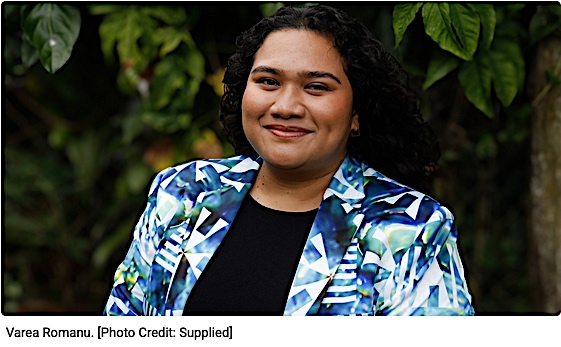
A childhood spent exploring the creeks and coastline of Ovalau inspired Varea Romanu to pursue a career in environmental conservation and climate resilience.
Romanu, who is of Rotuman heritage with Indo-Fijian maternal ties, was raised in the chiefly village of Levuka-Vaka-Viti, where she developed a strong connection to the environment.
“I was always in the water,” she said.
“Swimming with my friends and spending entire days in the creek, even if it meant catching colds and earaches during the school holidays.”
Her passion for the environment led her to study Environmental Science at the University of the South Pacific.
She later completed a Postgraduate Diploma in Climate Change and is currently pursuing a Master’s in Environmental Management.
Her research focuses on nature-based solutions to address coastal erosion in Rotuma, helping communities respond to the impacts of climate change.
“At USP, environmental issues weren’t abstract. They reflected what our communities were already experiencing, from coastal erosion to changing weather patterns and declining reef health.”
Romanu says studying alongside students from across the Pacific strengthened her understanding of the region’s shared environmental challenges.
She believes environmental protection is about more than science.
“It’s about people, livelihoods, culture and community wellbeing.”
Today, Romanu is the Project Coordinator for the Women POWER (Pacific Oceanic Women Enhancing Resilience) project with Oxfam in the Pacific.
The initiative supports women’s leadership in climate resilience and community decision-making across Pacific Island countries.
“Resilient communities are built when women’s voices, knowledge and leadership are recognised.”
Romanu says one of the highlights of her career has been working with communities, including Votua village on Fiji’s Coral Coast, where conservation efforts have helped restore marine ecosystems.
“It was incredible to see how community effort can restore and protect resources.”
She says these experiences reinforced the importance of combining traditional knowledge with science to protect the environment.
Outside work, Romanu is a wife and mother of two.
She says motherhood has strengthened her commitment to protecting the environment for future generations.
“When you have children, you think about the world they will inherit. The oceans they will swim in and the communities they will grow up in. That’s why this work matters.”
Romanu also volunteers with iTaukei Women in Conservation, promoting coral restoration and environmental awareness in communities.
She believes lasting change comes when communities are actively involved in protecting their natural resources.
“One of the most powerful things we can do is connect science with community action. When people understand the value of their natural resources and are supported to protect them, change becomes sustainable.”
Her advice to young people, particularly women interested in environmental science, is to remain confident and take opportunities as they come.
“Believe in the value of your voice. You don’t have to wait until you feel ready. Leadership comes in many forms. Sometimes it’s simply showing up and doing the work that matters.”
Romanu hopes more young Pacific Islanders will pursue careers in environmental science and help build a more climate-resilient future for the region.
From Fiji Village (1 July 2026)
In the Pacific, where the rhythms of life are shaped by the ocean, land, and community, environmental stewardship is not simply a profession; it is a way of life.
For Varea Romanu, this understanding began in childhood and continues to guide her work today as a leading advocate for climate resilience and women’s empowerment across the region.
Born of Rotuman heritage with Indo-Fijian maternal ties, Varea’s story is one deeply grounded in identity, culture, and place.
Though her roots trace back to Rotuma, she was raised on the historic island of Ovalau in Fiji’s Lomaiviti group, where her father settled as a young man. Growing up in the chiefly village of Levuka-Vaka-Viti, she was immersed in the natural environment, living close to the creek, the sea, and the land.
“I was always in the water,” she recalls with a smile. “Swimming with my friends, spending entire days in the creek, even if it meant catching colds and earaches during school holidays.”
These formative experiences nurtured a deep appreciation for the interconnectedness between people and their environment, a connection that would later shape her academic journey and professional path.
Varea pursued a Bachelor of Science (Environmental Science) at The University of the South Pacific (USP), a decision that felt both natural and necessary given her upbringing. Since then, she has expanded her expertise with a Postgraduate Diploma in Climate Change and is currently undertaking a Master’s in Environmental Management.
Her research focuses on Nature-based Solutions (NbS) to address coastal erosion in Rotuma, an issue exacerbated by climate change and one that directly impacts livelihoods, ecosystems, and cultural heritage.
“At USP, environmental issues weren’t abstract,” she explains. “They reflected what our communities were already experiencing: coastal erosion, changing weather patterns and declining reef health. The science helped me better understand and respond to these realities.”
USP also offered something equally valuable: a regional perspective. Studying alongside peers from across the Pacific broadened her understanding of shared environmental challenges and reinforced the importance of collaboration in addressing them.
For Varea, one of the most significant lessons from her time at USP was that environmental solutions were technical but also deeply social.
“Environmental protection is about people,” she says. “It’s about livelihoods, culture, and community wellbeing.”
This insight has become central to her work today as Project Coordinator for the Women POWER (Pacific Oceanic Women Enhancing Resilience) project with Oxfam in the Pacific.
The initiative focuses on strengthening women’s leadership in climate resilience efforts across multiple Pacific Island countries.
Recognising the intersection between gender inequality and climate vulnerability, the project empowers women to take active roles in decision-making, adaptation strategies, and community resilience.
“Resilient communities are built when women’s voices, knowledge, and leadership are recognised,” she emphasises.
While academic training laid a strong foundation, it was fieldwork that left a lasting impression. Varea fondly recalls visits to communities such as Votua village along Fiji’s Coral Coast, where locally managed marine areas have led to thriving coral ecosystems and abundant marine life.
“It was incredible to see how community effort can restore and protect resources,” she says. “These experiences showed me the power of combining local knowledge with conservation practices.”
Such lessons continue to influence her approach, one that prioritises community-driven solutions and respect for traditional environmental stewardship.
Beyond her professional accomplishments, Varea is a devoted wife and mother of two young children. Balancing family life with a demanding career in climate and development is not without challenges. Still, she credits her strong support system, her husband, parents, in-laws, and wider community for helping her manage both roles.
More importantly, motherhood has deepened her sense of purpose.
“When you have children, you think about the world they will inherit,” she reflects. “The oceans they will swim in, the communities they will grow up in, that’s why this work matters.”
To her, climate change is a deeply personal responsibility to future generations.
Living in the Pacific, Varea understands the central role of the ocean in sustaining life, culture, and economies. This awareness has driven her growing involvement in coral restoration and environmental awareness initiatives.
She recently began volunteering with iTaukei Women in Conservation (iTWC), an organisation dedicated to empowering women in conservation and promoting coral restoration practices within communities.
“One of the most powerful things we can do is connect science with community action,” she says. “When people understand the value of their natural resources and are supported to protect them, change becomes sustainable.”
Outside of her professional commitments, Varea finds joy in spending time with her family, taking long walks, sewing, and engaging in conversations that spark new ideas and learning.
To students at USP, especially young women, she offers a message of encouragement and empowerment:
“Believe in the value of your voice,” she says. “You don’t have to wait until you feel ready. Leadership comes in many forms - sometimes it’s simply showing up and doing the work that matters.”
Her message resonates across the Pacific, where the next generation of leaders will play a critical role in navigating the region’s environmental challenges.
Varea Romanu’s journey reflects a powerful blend of heritage, education, and purpose.
From a childhood spent in the creeks of Levuka to influencing regional climate initiatives, her work embodies the essence of Pacific resilience.
In a time when climate change poses unprecedented challenges, her story is a reminder that solutions are rooted not only in science but in people, their knowledge, their leadership, and their unwavering commitment to protecting the future.
As the Pacific continues to confront the realities of a changing climate, voices like Varea’s are helping to chart a path forward - one grounded in community, equity, and hope.